Wednesday, March 30, 2011

Tacoma Passes Weak Rental Inpsection Ordinance

The City of Tacoma, Washington has passed a rental inspection ordinance - "lite". Landlords in Tacoma have already had to obtain a business license to operate a rental since 2004 (Click here for more information) Unfortunately, the addition to the municipal code, entitled Provisional Rental Property License, passed by the Tacoma City Council earlier this year, calls for inspections only at the time the city discovers that there are problems with the rental.

A report of poor conditions can come from a renter; from an official of the city, who may incidentally view violations; or any citizen, such as a neighbor who might have knowledge of a problem. This is equivalent to the complaint-based systems, in existence in many cities, that do not work. The Centers for Disease Control have spoken on complaint-based systems and has judged them ineffective (click here to read the document).

You can read the new Tacoma ordinance by clicking here. You can read a Tacoma Weekly article and a King5 News piece on the topic by clicking here and here.

The Zonemaven immediately became suspicious regarding the strength of the law at the time he discovered that the Tacoma ordinance had been supported by the local rental owners' group, the Rental Housing Association. Our equivalent local Northwest Rental Owners' Association is vehemently opposed to any rental licensing in Bellingham. Any indication that this group begins to support rental licensing is a flag that the specific licensing proposal is not really worth considering as it will be inherently weak.

Other cities in Washington have passed more robust licensing and inspection ordinances. Pasco has had a very effective licensing ordinance for over a decade. Tukwila, Prosser and Seattle passed rental licensing ordinances in 2010. Unfortunately, Bellingham appears poised to follow the example of Tacoma with a rental-licensing-"lite" proposal, soon to be on the table. More on that in a later blog entry.

The Tacoma ordinance is scheduled to go into effect on January 1, 2012.


Thursday, March 3, 2011

WWU Students Recount Dangerous Rental Conditions To The City Council

Four WWU students described dangerous rental conditions before the Bellingham City Council on February 28th. During the public comment period, they told Council members about mold, water leaks, sagging floors, collapsing ceilings, inoperable heating systems and inadequate safety exits. You can review the video of the Council meeting by clicking here. Student comments begin at 8 minutes into the video.

Nicole Hicks stated that she became involved as she thought it was the right thing to do when she found out that there was no rental licensing and inspection in this city. While salons and restaurants where one spends relatively little time are licensed, she said, rentals in which one spends much more time are not inspected by the city. She then described her present apartment the entrance to which is a fire escape on an alley. The only other egress is a ladder that leads to a skylight (and then another ladder to the roof) and a window that opens inward but only with a 6 inch gap. Nicole also described an encounter with a prospective landlord who, when challenged about the existence of a 5th bedroom in a house advertised as a 5 bedroom, said that he would create the 5th bedroom in the living room by installing a panel.

Wesley Dyer, a senior and the leader of the Viking Community Builders club, described problems with mold in the units he has rented. [Mold can be very dangerous to those with allergies.] He went on to tell of a friend whose unit was infiltrated by water leaking from above, a ceiling that had partially collapsed and flooring under a tub above that was about to fall through to his floor.

Christopher Brown told of a "landlord" who admitted that no repairs had been done in his rental for 18 years. There was mold, trash from a previous tenant, broken heaters and cracked windows. The "landlord's" excuse was that the organization that owned the rental was low on money and could not effect the repairs.

Andrea Lavelle spoke about her rental unit that had slugs and mold when she moved in. When she complained, she was given a can of bug spray and some bleach. [Note: Bleach kills only certain molds on particular (hard) surfaces. It is not a universal means for mold abatement. OSHA and EPA have revised their guidelines to reflect this remediation problem. Click here and here for more information.] Conditions in her rental became so intolerable (there was a large hole in the side of the building where the wood siding and exposed insulation had rotted) that she complained to the city. The inspector declared the building structurally unsound and thus inhabitable. She was eventually able to break the lease based on the inspector's report.

These students also spoke more generally about rental conditions and the lack of knowledge among their peers. They spoke of not having sufficient expertise to judge the worthiness of a rental before moving in. They spoke of the need for expert evaluation of rentals within the context of a rental licensing and inspection program. They referred to the proposal that was made by the Planning Committee of the City Council on March 24th as being a tentative first step but inadequate to the task at hand, complete rental safety. (Click here to see Councilman Weiss's proposal adopted by the committee.) They specifically spoke to the inadequacies of self-certification, complaint-based systems and licensing/inspection-lite, i.e., going after bad apples only.

Two weeks earlier at the City Council meeting, WWU student Chris Chatburn told the City Council during the comment period "The problem that I am talking about is, of course, sub-standard rental housing in our Bellingham community. As the coordinator of the Associated Students Legal Information Center, I’ve heard hundreds of horror stories from renters detailing significant and serious problems with their homes. An incredibly high percentage of Western students are renters in the community and I have yet to meet one of them that hasn’t run into some problem renting in our community. I have myself been a victim of sub-standard rental housing. We must act now to implement rental licensing with inspections in our city." (Click here to read Chris's entire statement.)

Thanks to these committed and articulate students, the City Council has yet another window onto the realities of the rental market in Bellingham.

Thursday, February 17, 2011

Bellingham Mayor's Commission Sends Him Second Message in Support of Rental Licensing

At its 16 February 2011 meeting, the Mayor's Neighborhood Advisory Commission (MNAC) reaffirmed its recommendation to Mayor Pike that he support the implementation of a rental licensing and inspection ordinance in Bellingham. This follows some very animated discussion on the topic during the February MNAC meeting (click here to read about that) The motion reads: "In order to maintain a safe, healthy rental housing stock, the Mayor's Neighborhood Advisory Commission recommends that Mayor Dan Pike support the implementation of a self-supporting, effective rental housing licensing and inspection program as soon as possible in 2011." (Vote was 13 yes, 5 no, and 1 abstention)


This motion was the second such recommendation to Mayor Pike. Last year on 17 March, MNAC sent a similar message to the Mayor, to wit: that
“a rental housing licensing and inspection ordinance be drawn up for review and discussion in 2010 in a public process." This recommendation was also approved by an overwhelming vote but was manifestly ignored by Mayor Pike. In fact, last year Mayor Pike and then Planning Director, Tim Stewart, actively sought to derail action on rental licensing and inspection by the City Council. Click here and here to read about the Mayor's tactics.


85% of the neighborhoods voting on the 16th, supported licensing and inspection with a statement even stronger than the one they sent Mayor Pike last year. Not an insignificant percentage. Perhaps this time this recommendation will not fall on deaf ears in the Office of the Mayor.


Wednesday, February 9, 2011

Rental Inspections - Pasco Did It With One Inspector


Over a decade ago, Pasco, WA decided to license and inspect its 6,000 rental units. One inspector, doing 8-10 inspections per day, completed the first inspection cycle in two years. He used the checklist pictured at left (click on the image to enlarge it). Not all units were inspected. Those rentals that fell under other inspection regimes, such as with HUD (Housing and Urban Development) or with state certified inspectors, were taken off the list. Only a sample percentage of apartment complex rental units were inspected. This also reduced the number of city inspections.

Bellingham has about 17,000 rental units. Using a methodology similar to that used in Pasco, two inspectors in Bellingham would be able to complete an initial inspection cycle easily in 3 years. This coincides with the restrictions placed on the frequency of inspection by the 2010 Washington State legislation on rental licensing, i.e., once every three years. (Click here to read Bill 6459)

So the horror stories from the landlords regarding the cost of a program to the city appear unfounded. In my recent exchange with the governmental affairs director of the Whatcom County Association of Realtors®, he claimed that, in talks with city officials here, they projected the program would need 5 or more inspectors and that they would only be able to perform several inspections per day - each. This is not born out by the Pasco experience. That is why I have continued to implore the city council to bring Mr. Mitch Nickolds, Pasco's code enforcement officer, to Bellingham to present the facts about initiating a licensing and inspection program for rentals. Instead our city executive opposes licensing and inspections and creates a poster child in the form of Auburn, WA; a city that licensed rentals but never instituted an inspection program.

In a recent conversation with Mitch Nickolds, I mentioned to him the contention by our mayor that Pasco is not a good example of licensing and inspection since there is such a large migrant worker population in Pasco vs. Bellingham. (My answer to the mayor here has been that we have our own migrant population in the form of students, more than 8,000 of whom pass through here on a yearly basis seeking housing.) Mr. Nickolds said that although they found substantial life threatening problems in the migrant worker rental housing, they also were surprised by the very serious problems found within the units occupied by the elderly. One can conclude that the migratory nature of the rental population is not the sole determinant of poor rental conditions as our mayor would have us accept. Indeed, more stable groups, such as the elderly, lend themselves to exploitation and poor housing conditions. One can add to this mixture the fact that during the second round of inspections two years later, Pasco found serious deterioration in many previously inspected units. This, after only two years.

Monday, February 7, 2011

Fire Marshall Reports on York Fires

The Bellingham Fire Marshal has issued his reports on the fires at 1404 Grant St and 1418 Ellis St. earlier this January. The Grant St. fire displaced its 4 renters, three of whom present would have perished had not one of them decided to get out of bed to eat. The fire on Ellis St. was contained to one unit in a home that had reportedly been renovated into several apartments. You can read about these events by clicking here, here and here.

The fire marshal investigates in order to rule out arson. He will provide information on the cause of the blaze but does not rule on who is at fault. This is done by an investigator so that fault may be assessed for insurance purposes. Unfortunately, these results may not be made public in the near future or ever for that matter.

Images of the appropriate portions of the report of the fire marshal on these two fires are on the left (click on them to enlarge). The Grant St. fire originated in an electrical junction box located in the attic above a bathroom. The cause was likely "arcing from loose connections" The report also indicated that "Smoke alarms were not installed in residence." (Further contact with the fire marshal revealed that this sentence means that there were no functioning smoke alarms in the home.) Two of the residents personally told the Zonemaven that they had reported this to the management company before the holidays. They had also indicated that the electrical system was also giving them trouble in the form of flickering lights and tripped circuit breakers.

As for the fire on Ellis St. it appears that the cause was a fan attached to a gas heater that had tripped a circuit breaker repeatedly the day before. The fan was held in place by bolts that were undersized allowing the fan to fall off the heater onto the rug where the fire started. The investigation also revealed that the house was rewired years ago, however, the installation was not inspected for compliance with codes. Earlier news reports indicated the smoke detector did not work.

Landlords will complain that they install smoke detectors that are then sabotaged by the tenants or not maintained by the tenants who neglect to replace the batteries. I might remind the landlords that the smoke alarms are the last line of defense and that it is the underlying condition of the home that is the basic question. Working smoke alarms do not make a rental safer, they merely protect the renter from possible harm if there is a fire. But smoke alarms do not help with issues of mold, plumbing, vermin, structural deficiencies, etc. With these issues the first indicator of a problem is often disease or injury.

During the Zonemaven's appearance on The Joe Show (click here to refresh your memory on that event), Mr. Perry Eskridge, Government Affairs Director of the Whatcom County Association of Realtors®, phoned with some comments on the Grant St. fire. He spoke to having had contact with the owner of the property who informed him that the home had been renovated in 1982 with monies from a block grant and that it conformed to code as of that date. The home had also been inspected by Housing and Urban Development (HUD). He further stated that 7 smoke alarms had been installed in the property in 2007 and that the tenant had the contractual responsibility to replace the batteries. Mr. Eskridge said also that there were three space heaters plugged into one outlet.

It seems to me that a house that was up to code in 1982 might need a bit of work by 2011 or, at least, a periodic inspection. In Bellingham, though, that is not necessary. As for the smoke alarm installation of 2007, I wonder the reason for which the management company did not take action on its own during that period. Does the company not make periodic visits to ensure the health and safety of the tenants as well as the condition of the building? (The Washington State landlord tenant law allows the landlord to enter the home with a 48hr notice.) Had no members of the management team entered the premises for four years? Was there turnover of the tenants during that period? As for the space heaters, one might ask the reason for which the tenants felt a need to install such devices. One usually does not use space heaters unless the central heating system is inadequate.

As mentioned above, because the fire is now under investigation by inspectors to determine fault for insurance purposes, we may never know the entire story. These matters tend to remain private, unless perhaps one of the former tenants takes the owner to court. Or, we can avoid most of these incidents by having a licensing and inspection program in Bellingham that will protect BOTH the tenant and the landlord.

Wednesday, February 2, 2011

Silence from Landlords on Rental Rate Increases

A recent story in the Bellingham Herald indicated a low rental vacancy rate in this area and suggested that, consequently, rental rates may rise as much as $50 per month. You can click here to read the story.

The shortage overall does not mean that vacancy rates in the county are equally low. Vacancies tend to be lesser in number in areas of high demand, such as close to Western Washington University (WWU) where we know who will bear the burden of higher rents - the students. So the prediction is that rents will rise in these areas not because of rising costs but because there is less competition. Hiking rates in the absence of competition is call greed.

Not surprisingly, I have not heard a flood of protest from the landlords or their associations about rental rate increases in this instance. We did hear from the landlords at the time they learned that they might have to pay the staggering sum of $3 per month, if a licensing and inspection program were to be created in Bellingham. They cried faux crocodile tears in loco parentis for the poor tenants who would have to bear the burden of the pass through of a potential $3/month fee even though there would be no obligation to pass the fee in the first place.

I have posited before in this blog that the landlords have needed no excuse in the past 30-40 years to increase rental rates in this city at the times it suited them. (Complicit in this was WWU and the city. WWU because it built no housing on campus for decades and the city because it allowed the huge influx of essentially migrant tenants without taking any steps to protect the neighborhoods or control the rental housing stock.) To wit: the $525 per month for the filthy dump described in my blog entry of 18 January (click here to read that) and the $1330 per month for the hovel on Grant St. that burned out the student renters last month (click here and here to refresh your memory on that event).

So I call upon the landlords to be true to their concern about rising rental rates due to licensing fees and to suppress the urge to raise rents for the simple reason that they can.

Tuesday, January 25, 2011

Fairhaven Rental - Off the Charts (A Sequel)


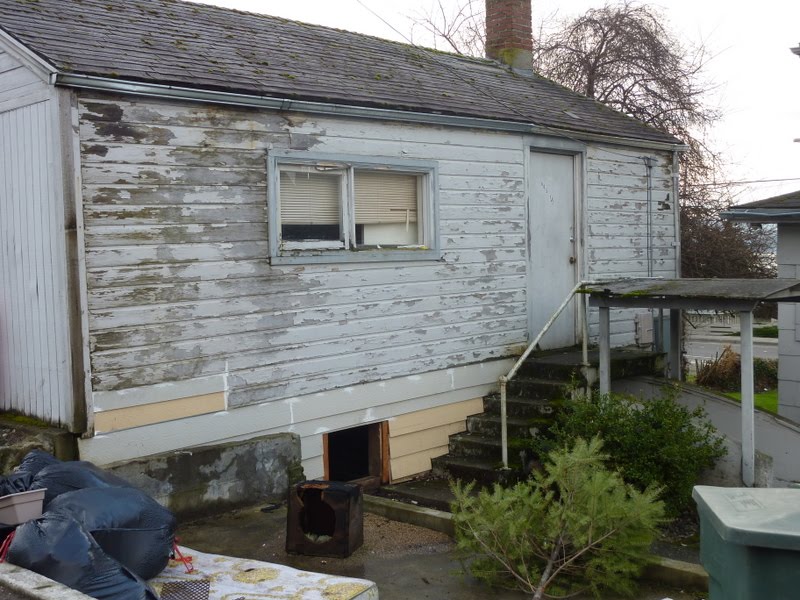
Last week the Zonemaven provided the story, as told by a parent of a WWU student, of a disaster of a detached ADU in Fairhaven. The ADU was on a lot that also contained a two-story, single family home that also appeared to be in questionable condition. Click here to refresh your memory on that horror show. A photo of the house and the detached ADU is at left.

A few days ago, the Zonemaven visited that house to give the renter(s) a flyer on taking the survey of rental conditions sponsored by the Viking Community Builders. (Click here for the survey) A young man answered the door and told the Zonemaven that he had just moved in weeks before and that he was a construction worker. He was vaguely aware of the problem with the ADU and knew that someone had just moved out. The Zonemaven spent a few minutes telling him the ADU story and then asked him if he had experienced any serious problems with his rental. He said "not really" and then invited me into the house to take a look.

First of all, the treads of the stairs leading to the small front porch had just been replaced however they were of uneven length. The treads were also not uniformly deep creating an uneven stair pattern. The entry way into the home was dirty and plaster was falling off the wall exposing the bricks underneath. The foyer linoleum was filthy and badly worn. Entering the living room, the Zonemaven discovered an aging and large gas heating unit on the floor that occupied about 20% of the room's floor space. The unit was vented through the wall, presumably to the outside, by metal stove pipe duct work. Several of the access panels of the unit were not in place, exposing what appeared to me to be the ignition element. Since the unit was on the floor, any object dropped on it could easily hit the inner workings of the heater.

Moving into the kitchen, the Zonemaven asked if the windows operated properly. He said that some did, however, the window above the sink would not lock and that he discovered that it would fall out of the window frame - so he screwed it shut. The door to the back foyer had a non-operational locking mechanism. The foyer had a plywood floor that was rotten at one end due to a hole in the wall that let the rain from outside flow from the concrete pad into the house. The kitchen appliances were old and worn but appeared operational. The enamel kitchen sink was badly worn.

The bathroom had recently been partially remodeled and the tub/shower area was new. The tub grout was already separating from the wall/tub junction at one end suggesting that the tub was moving vertically either because of the weight of the person in the shower or because the floor was not stable or both. In fact, the floor was visibly slanted toward the tub and the tenant opined that the sub-floor might be rotted.

The house was badly in need of paint and the gutters in the rear were twisted and partially separated from the eaves. The Zonemaven had no access to the second floor of the residence that was a separate living unit. The renter was not available.

Upon leaving the residence, the Zonemaven went to the alley behind the home where the dilapidated ADU was located. This was the unit mentioned in the first paragraph above. Since the departure of the student renter, the entire south side of the ADU had been stripped of its siding. This was the side that had rotted completely away in one corner.

More from the mother of the student: "Icing on the cake-- My daughter actually cleaned this place before she left so she could get her deposit back! (Including black mold that covered the bedroom wall behind her bed.) They returned the deposit less $75 for carpet cleaning! The carpet was not cleaned before she moved in nor before her housemate at the time, who moved in prior to her. I can't imagine they are going to clean the carpet now. She is not sure if they are tearing down the whole building or just the wall. I was under the impression it was the whole building, but not sure why." ... "FYI her place just had the 2-pronged plugs also. I also wondered about her ancient appliances. It seems the city inspected [as the result of their formal complaint in December] the structural aspects but not the electrical. Hopefully Bellingham will start to have rental inspections!"

She goes on in a later email: "When I first visited my daughter in Feb of last yr I bought her a smoke and CO2 detector because her smoke alarm didn't work right and everything was so old I thought it very possible that it might save her life. The smoke detector that was provided went off continually every time she took a shower and the steam came up from downstairs (since there was no ventilation) so she took the battery out. Not a good thing to do, but I wonder how many ...tenants have the same problem and remove the batteries? ... It seems that for some of these realtors, avoiding blame is all they are really concerned about, not the safety of residents. It is pretty disgusting."

The Zonemaven encourages the residents of Bellingham, especially the renters, to write to the mayor (mayorsoffice@cob.org) and to the city council (ccmail@cob.org) and ask them to do the right thing, license and inspect rentals.